

Complex Regional Pain Syndrome (CRPS) Care in Sugar Land TX
At Modern Pain Management, Dr. George Atallah, DO, provides compassionate, evidence-based care for patients struggling with the debilitating effects of Complex Regional Pain Syndrome. Our clinic specializes in diagnosing this often-misunderstood condition and developing customized treatment plans that prioritize functional recovery and long-term relief. For more information, contact us or schedule a consultation. We are located at 12930 Dairy Ashford Rd #501-504, Sugar Land, TX 77478.
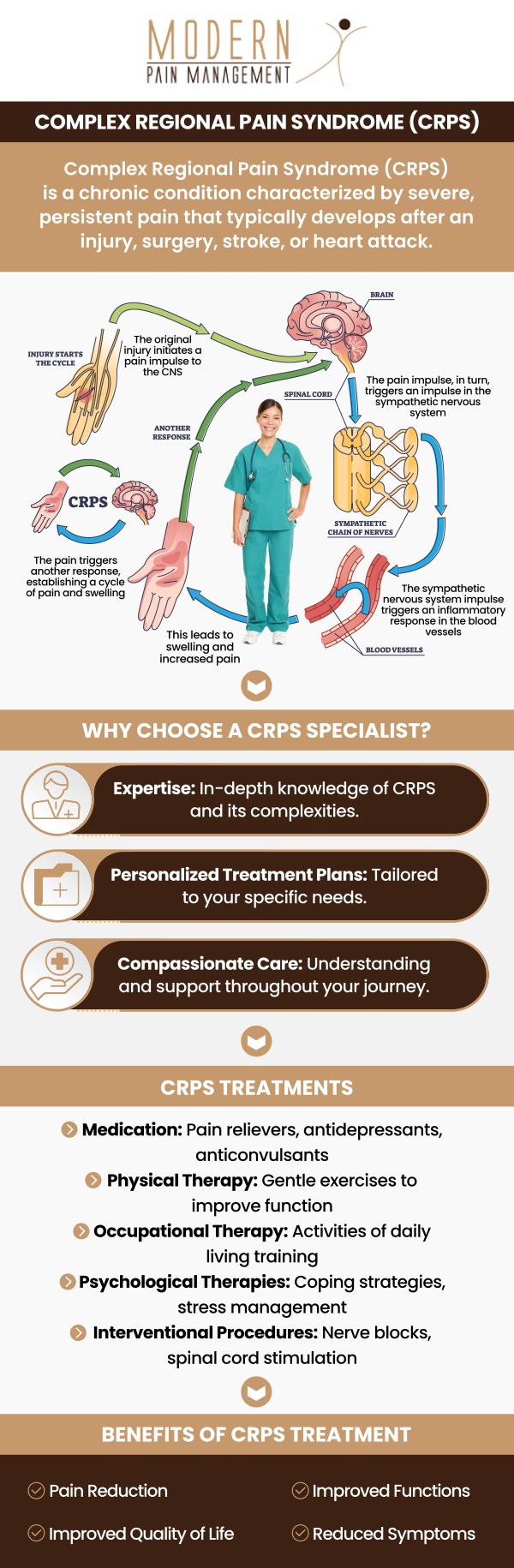
Table of Contents:
Is my persistent burning pain actually CRPS?
What should I bring to my first CRPS consultation in Sugar Land?
Why is early intervention critical for CRPS recovery?
Why is CRPS so difficult to treat, and how can a Sugar Land specialist help?
What interventional therapies do you offer for CRPS in Sugar Land?
How does Dr. George Atallah, DO personalize your CRPS journey?
Persistent, searing pain that feels out of proportion to a previous injury is the hallmark of Complex Regional Pain Syndrome. While many types of chronic pain exist, CRPS is distinct because of its “autonomic” symptoms. If you notice that your affected limb is not just painful, but also exhibits changes in skin color (turning red, blue, or mottled), temperature (feeling significantly hotter or colder than the other side), or unusual swelling, it may be CRPS.
Patients often describe a “burning” or “pins and needles” sensation that spreads beyond the original site of trauma. You might also notice changes in hair or nail growth patterns in the area, or skin that has become shiny and thin. Because CRPS involves a malfunction of the central and peripheral nervous systems, the pain can be triggered by even the lightest touch—a condition known as allodynia. If these symptoms sound familiar, a formal evaluation at Modern Pain Management is essential to distinguish CRPS from standard nerve damage or localized inflammation.
Preparation is key to an accurate diagnosis. Since CRPS is often a “diagnosis of exclusion,” Dr. Atallah, DO, will need to review your full medical history to rule out other conditions. Please bring any recent imaging (MRI, X-ray, or CT scans) and reports from previous specialists.
It is also incredibly helpful to keep a “pain diary” for a week leading up to your appointment. Note the times of day your pain peaks, specific triggers (like cold weather or stress), and any visible physical changes you’ve observed. A complete list of your current medications and past treatments—such as physical therapy or nerve blocks—will help us understand what has or hasn’t worked. Having this information ready allows our team to spend more time focusing on your physical examination and discussing your specific recovery goals.
Time is of the essence when dealing with CRPS. There is a “golden window” for treatment, typically within the first six months of symptom onset, where the nervous system is most responsive to intervention. If left untreated, the brain and spinal cord can undergo “central sensitization,” where the pain becomes hardwired into the nervous system, making it much more difficult to reverse.
Early intervention prevents secondary complications like muscle atrophy (wasting) and joint contractures (stiffening). When we catch CRPS early at our Sugar Land clinic, we can implement therapies that “calm” the overactive nerves before permanent changes occur. Delaying treatment often leads to a cycle of immobility and psychological distress, whereas early action significantly increases the chances of achieving clinical remission.
CRPS is notoriously complex because it isn’t just a bone or muscle issue; it is a multi-system failure involving the immune system, the vascular system, and the nerves. Because the pain is “invisible” on many standard tests, patients often feel dismissed by the medical community.
A specialist like Dr. Atallah, DO, understands the “Wind-Up Phenomenon” associated with CRPS. We look at the patient as a whole, addressing the physical symptoms while also managing the neurological aspects of the disease. By using a multidisciplinary approach—combining medication management, sympathetic blocks, and specialized physical therapy—we can attack the pain from multiple angles. Our goal is to break the pain loop and retrain the brain to process sensory information normally again.
Modern Pain Management offers several advanced interventional procedures designed to interrupt the pain signals associated with CRPS. These include:
• Sympathetic Nerve Blocks: By injecting anesthetic near the spine, we can block the “fight or flight” nerves that are overreacting and causing the burning sensation and blood flow issues.
• Stellate Ganglion Blocks: Used primarily for CRPS affecting the arms or face, this procedure can provide immediate cooling and relief.
• Lumbar Sympathetic Blocks: Target CRPS symptoms in the lower extremities.
• Spinal Cord Stimulation (SCS): For chronic cases, we may use SCS technology, which involves a small device that sends electrical pulses to the spinal cord to mask pain signals before they reach the brain.
• Ketamine Infusion Therapy: An emerging treatment that can help “reset” NMDA receptors in the brain to reduce systemic pain.
At Modern Pain Management, Dr. George Atallah, DO, believes that no two cases of CRPS are identical. He takes a “patient-first” approach, moving beyond generic protocols to identify the specific stage and subtype of your condition. By integrating cutting-edge interventional techniques with a focus on restoring mobility, Dr. Atallah ensures that every resident of Sugar Land receives a tailored roadmap to recovery. He focuses on empowering patients through education and precise clinical procedures, ensuring that you are a partner in your healing process rather than just a passive recipient of care.
Find effective CRPS treatment options Modern Pain Management, designed to help manage symptoms and improve quality of life. For more information, contact us or schedule a consultation. We are located at 12930 Dairy Ashford Rd #501-504, Sugar Land, TX 77478. We serve patients from Sugar Land TX, Houston TX, Pearland TX, Jersey Village TX, Missouri City TX, Stafford TX, and Richmond TX.
Check Out Our 5 Star Reviews

ADDITIONAL SERVICES YOU MAY NEED





 Send Text
 How May I Help You?