

Lower Back Pain Radiating Down My Leg: Causes and Treatment in Houston, TX
Lower back pain that travels down the leg may be caused by nerve irritation, sciatica, herniated discs, or other spine-related conditions. At Modern Pain Management, Dr. George Atallah, D.O., and the team focus on identifying the underlying cause of discomfort and developing personalized pain management plans to help improve mobility and quality of life. For more information, contact us or request an appointment online. We are located at 902 Frostwood Dr #235, Houston, TX 77024.
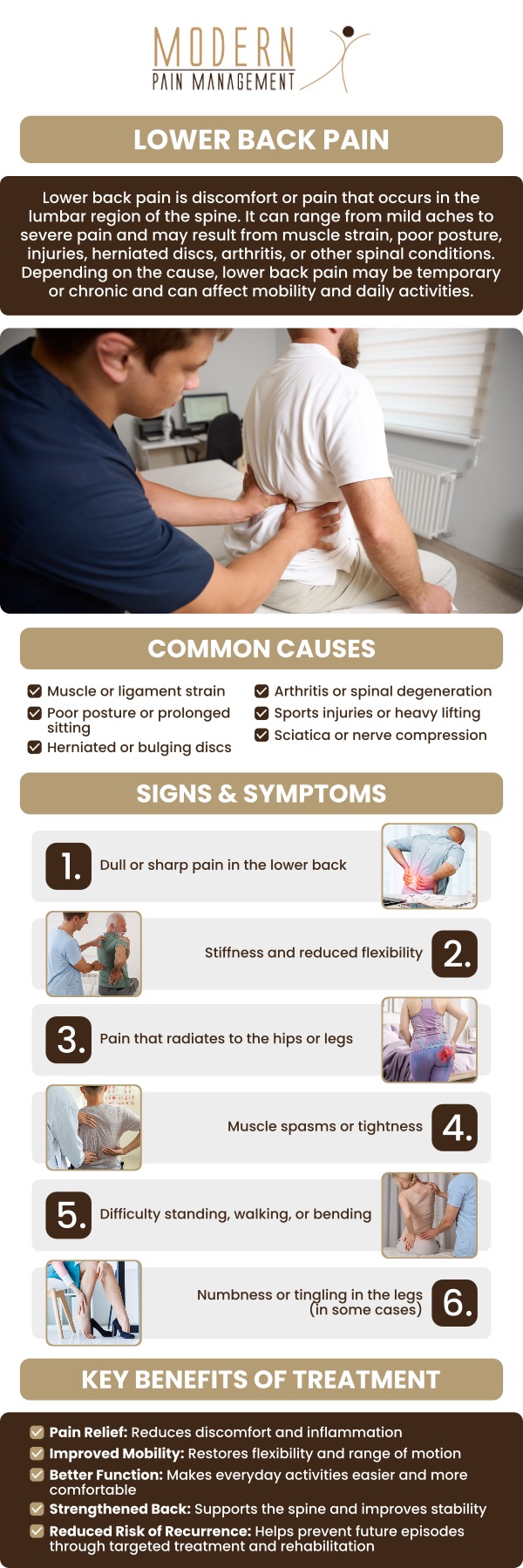
Table of Contents:
Why does lower back pain sometimes spread into the leg?
What conditions can cause lower back pain that travels down the leg?
How is radiating lower back pain diagnosed by a pain specialist?
Can lower back pain that extends to the leg improve with proper treatment?
What factors may affect treatment options for radiating lower back pain?
How does Modern Pain Management help patients manage lower back pain in Houston, TX?
At Modern Pain Management, we frequently see patients who experience lower back pain that spreads into the leg—a symptom that often raises concern and can significantly impact daily life. This type of pain is commonly caused by irritation or compression of the nerves that exit the lower spine. One of the most frequent culprits is sciatica, which occurs when the sciatic nerve becomes pinched or inflamed. The sciatic nerve, the longest nerve in the body, travels from the lower back down through the hips, buttocks, and into each leg. When structures in the lower back—such as a herniated disc, bone spur, or narrowing of the spinal canal—put pressure on this nerve, patients may experience pain radiating from the lower back into the buttock, thigh, calf, or even the foot.
At Modern Pain Management, our team is experienced in diagnosing and treating a variety of spinal conditions, including degenerative disc disease and spinal stenosis, which may also cause nerve irritation or compression and produce similar radiating pain. Additionally, muscle strain in the lower back can sometimes cause referred pain, making it feel as though the pain is spreading into the leg, even if the nerve itself is not directly involved.
If you are experiencing lower back pain that radiates into your leg—especially if you notice numbness, tingling, weakness, or difficulty controlling the leg—it’s important to seek a comprehensive evaluation. These symptoms may indicate nerve involvement and require prompt medical attention to determine the underlying cause and develop an effective treatment plan.
Lower back pain that radiates down the leg is a common symptom often associated with nerve involvement, and it’s a condition we frequently see at Modern Pain Management. One of the most frequent causes is sciatica, which develops when the sciatic nerve is irritated or compressed—often due to a herniated disc or degenerative changes in the spine. A herniated disc occurs when the soft center of a spinal disc pushes through its tougher exterior, putting pressure on nearby nerves. Similarly, spinal stenosis, which is the narrowing of the spinal canal, can also compress nerves and lead to pain that travels from the lower back down the leg.
Other conditions we evaluate at Modern Pain Management include spondylolisthesis, where a vertebra slips out of place and may press on nerves serving the legs, and degenerative disc disease, which involves the breakdown of discs between the vertebrae—both of which can cause radiating pain. Piriformis syndrome, where the piriformis muscle in the buttock irritates the sciatic nerve, is another potential source of these symptoms. Less commonly, tumors, infections, or trauma in the lower back or pelvis can also be underlying causes.
At Modern Pain Management, radiating lower back pain is one of the most common concerns we help patients address. Our board-certified pain specialists utilize a comprehensive, evidence-based approach to diagnose and treat the underlying causes of lower back pain, ensuring each patient receives individualized care.
Your journey at Modern Pain Management begins with an in-depth consultation. Our specialists take the time to thoroughly review your medical history, asking detailed questions about when your pain began, its duration, severity, and quality. We also discuss any activities or positions that worsen or relieve your symptoms, as well as associated issues like numbness, tingling, muscle weakness, or changes in bowel or bladder function—important indicators of possible nerve involvement.
Next, our providers perform a meticulous physical examination tailored to your symptoms. This includes assessing your back’s range of motion, identifying areas of tenderness or muscle spasm, and conducting neurological assessments to evaluate reflexes, sensation, and muscle strength in your lower extremities. Special tests, such as the straight leg raise, help us pinpoint nerve root irritation, which is often seen in cases like sciatica.
If your pain is severe, persistent, or accompanied by neurological symptoms, we may recommend advanced imaging studies. Modern Pain Management offers access to high-resolution imaging such as X-rays, MRIs, and CT scans. These tools help us visualize bone, disc, nerve, and soft tissue abnormalities. When needed, we can also perform nerve conduction studies or electromyography (EMG) to accurately assess nerve function and localize any nerve compression or injury.
By integrating information from your medical history, physical examination, and diagnostic tests, our team can determine the most likely cause of your radiating lower back pain—whether it’s a herniated disc, spinal stenosis, or another nerve impingement condition. This comprehensive diagnostic process is the foundation for developing a personalized treatment plan that may include interventional procedures, medication management, physical therapy, and minimally invasive options.
At Modern Pain Management, our goal is to relieve your pain, restore your function, and enhance your quality of life through cutting-edge care and compassionate service.
Lower back pain that radiates into the leg—often caused by nerve involvement from conditions like sciatica or a herniated disc—is a common concern we address at Modern Pain Management.
At Modern Pain Management, your care begins with a thorough evaluation to determine the underlying cause of your symptoms. We emphasize conservative, non-surgical treatments as first-line therapies. These may include customized physical therapy plans, targeted exercise regimens, anti-inflammatory medications, and guidance on lifestyle modifications such as ergonomic adjustments and weight management.
For patients who need additional relief, our physicians are skilled in performing advanced pain interventions, including epidural steroid injections and other minimally invasive procedures designed to reduce inflammation and provide lasting comfort.
Most of our patients experience significant improvement as inflammation decreases and nerve function recovers; however, recovery time can vary based on individual factors and the severity of the condition. Our team at Modern Pain Management closely monitors each patient’s progress and adjusts treatment plans as needed to ensure the best possible outcomes.
At Modern Pain Management, we recognize that several factors influence the most effective treatment options for radiating lower back pain. One of the most important considerations is identifying the underlying cause, which may include herniated discs, spinal stenosis, muscle strain, or nerve compression.
We also evaluate your age, overall health, and any coexisting medical conditions—such as diabetes or osteoporosis—to ensure recommended therapies are both safe and effective for you. Your response to previous treatments, whether medications, physical therapy, or interventional procedures like injections, helps guide our next steps.
At Modern Pain Management, we also consider lifestyle factors, including your activity level, occupation, and personal preferences, to tailor a treatment plan that fits your needs. Advanced imaging, such as MRI or CT scans, may be utilized to further clarify the cause of your pain and refine your personalized treatment strategy.
Ultimately, our patient-centered approach at Modern Pain Management takes all these factors into account, allowing us to provide comprehensive and effective care for radiating lower back pain.
At Modern Pain Management, we are dedicated to providing comprehensive and compassionate care for patients struggling with lower back pain in the Houston area. Dr. Atallah, DO, and our board-certified pain specialists understand that every patient’s pain is unique, which is why we begin each journey with an in-depth evaluation. Using advanced diagnostic tools and state-of-the-art medical imaging, our team works to pinpoint the exact source of your discomfort—whether it’s caused by muscle strain, herniated discs, arthritis, or other spinal conditions.
Once we determine the underlying cause, Modern Pain Management creates a personalized treatment plan designed for maximum relief and long-term improvement. Our evidence-based approach incorporates a variety of interventional pain management techniques, such as corticosteroid injections, nerve blocks, and minimally invasive procedures that precisely target pain at its source.
Medication management is available when appropriate, always under careful supervision to minimize risks and side effects. For patients with chronic or severe lower back pain, we provide advanced options like radiofrequency ablation and spinal cord stimulation, offering the latest in pain relief technology.
With a focus on innovative treatments, individualized care, and ongoing support, Modern Pain Management is committed to helping patients in Houston find meaningful relief from lower back pain—addressing not just the symptoms, but their root causes. For more information, contact us or request an appointment online. We are located at 902 Frostwood Dr #235, Houston, TX 77024. We serve patients from Houston TX, Sugar Land TX, Pearland TX, Jersey Village TX, Missouri TX, Stafford TX, and Richmond TX.
Check Out Our 5 Star Reviews

ADDITIONAL SERVICES YOU MAY NEED





 Send Text
 How May I Help You?