

Understanding CRPS: Your Path to Healing Starts Here in Houston
Complex Regional Pain Syndrome (CRPS) is a multifaceted neurological condition that requires a highly specialized approach to diagnosis and management. At Modern Pain Management, we recognize that CRPS is more than just physical discomfort; it is a life-altering condition that demands both clinical precision and genuine empathy. Under the guidance of Dr. George Atallah, DO, our team targets the nervous system’s “misfiring” signals, helping patients reclaim their quality of life. Contact us or book an appointment online today. We are located at 902 Frostwood Dr #235, Houston, TX 77024.
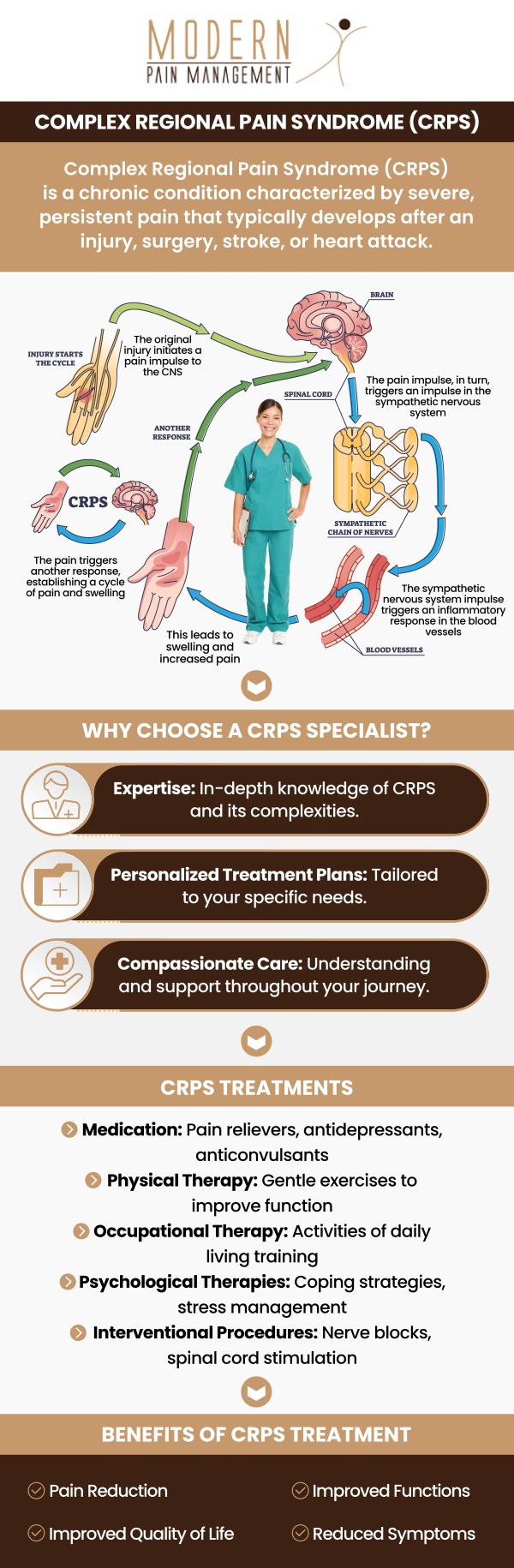
Table of Contents:
Is CRPS related to other conditions, and how does it differ from other types of pain disorders?
What are the long-term outlooks for individuals diagnosed with CRPS?
How does CRPS impact mobility and function in affected limbs?
Can CRPS be triggered by an injury, and how long after an injury does CRPS typically develop?
How does Dr. George Atallah, DO personalize CRPS treatments to provide more than just temporary relief?
CRPS is often described as a “malfunction” of the central and peripheral nervous systems. While many chronic pain conditions, such as fibromyalgia or neuropathy, involve widespread or localized nerve pain, CRPS is distinct due to its unique clinical presentation involving the autonomic nervous system.
Unlike standard neuropathic pain, CRPS is characterized by autonomic dysfunction. This means that in addition to high levels of pain, patients experience visible changes in the affected limb, such as skin color shifts (red, blue, or mottled), temperature fluctuations, and abnormal sweating. It is often compared to a “short circuit” in the body’s alarm system; while a typical injury heals and the pain subsides, in a CRPS patient, the alarm stays stuck in the “on” position, often amplifying the sensation far beyond the original stimulus.
While it shares some sensory similarities with Small Fiber Neuropathy or Raynaud’s Phenomenon, CRPS is distinguished by the Budapest Criteria, a specific set of diagnostic markers used by specialists to confirm the presence of sensory, vasomotor, and sudomotor changes. This distinction is vital because the treatments that work for general back pain or arthritis are often ineffective for the hyper-sensitized pathways found in CRPS.
The prognosis for CRPS has improved significantly over the last decade due to the shift toward early interventional care. The long-term outlook is generally categorized into two paths: remission or management.
• Early Intervention: When caught within the first six to twelve months (often referred to as the “acute” or “warm” stage), there is a much higher likelihood of achieving long-term remission. During this window, the nervous system is more “plastic” and responsive to treatments like sympathetic nerve blocks or physical therapy.
• Chronic Management: For individuals who have lived with CRPS for several years, the focus shifts toward functional restoration and technological intervention. While the condition may not “disappear,” many patients lead full, active lives through the use of Spinal Cord Stimulation (SCS) or DRG (Dorsal Root Ganglion) Stimulation.
The goal at Modern Pain Management is to prevent the “atrophy” of a patient’s lifestyle. With a consistent, multifaceted treatment plan, many individuals see a significant reduction in flares and a stabilization of their autonomic symptoms over time.
One of the most challenging aspects of CRPS is the “fear-avoidance” cycle. Because the affected limb is hypersensitive—a condition known as allodynia, where even a light breeze or the touch of clothing causes intense pain—patients naturally stop moving the limb.
This lack of movement leads to a cascade of functional issues:
• Muscle Atrophy: Without use, the muscles in the arm or leg begin to waste away.
• Contractures: The tendons can shorten, causing the fingers or toes to “claw” or become fixed in a curled position.
• Bone Density Loss: In advanced cases, the lack of weight-bearing activity leads to localized osteoporosis (Sudeck’s atrophy).
• Proprioception Issues: The brain can actually begin to “neglect” the limb, making it feel heavy, clumsy, or as if it doesn’t belong to the body.
Effective therapy focuses on “retraining” the brain’s map of the limb through graded motor imagery and desensitization, ensuring that mobility is preserved even while the pain is being managed.
Yes, the vast majority of CRPS cases (roughly 90%) are triggered by a clear inciting event or injury. Interestingly, the severity of the CRPS is not always proportional to the severity of the initial trauma. A minor sprain or a simple needle stick can trigger CRPS just as easily as a complex bone fracture or a major surgical procedure.
Typically, CRPS symptoms begin to develop within four to six weeks after the initial injury or surgery. Patients may notice that as the initial wound or break heals, the pain actually gets worse instead of better. Common triggers include:
• Fractures: Particularly in the wrist (Colles’ fracture) or ankles.
• Soft Tissue Trauma: Sprains, burns, or crush injuries.
• Surgical Procedures: Especially those involving the extremities.
• Immobilization: Prolonged casting of a limb can sometimes predispose the nervous system to develop CRPS.
If you notice that your pain is spreading beyond the original site of injury or that your skin is changing color and texture weeks after an accident, it is imperative to seek a specialist’s opinion immediately.
Dr. George Atallah, DO understands that CRPS is an “invisible” illness that can leave patients feeling isolated and misunderstood. His osteopathic background informs a whole-person approach, addressing how chronic pain impacts the entire body’s alignment and function. By utilizing the latest advancements in neuromodulation—such as Dorsal Root Ganglion (DRG) therapy, which is specifically designed for localized pain in the lower extremities—he targets the “gatekeeper” of pain signals. At Modern Pain Management, treatment is never one-size-fits-all; it is an evolving partnership where advanced interventional techniques are used to “quiet” the nervous system, allowing patients to successfully participate in physical therapy and reclaim their independence.
Living with CRPS requires a team that understands the complex language of the nervous system. By integrating early diagnosis, empathetic care, and the most sophisticated interventional technologies available in Houston, we strive to turn the tide against chronic pain. Your journey toward healing is a marathon, not a sprint, and we are committed to being with you every step of the way. Contact us or book an appointment online today. We are located at 902 Frostwood Dr #235, Houston, TX 77024. We serve patients from Houston TX, Sugar Land TX, Pearland TX, Jersey Village TX, Missouri TX, Stafford TX, and Richmond TX.
Check Out Our 5 Star Reviews

ADDITIONAL SERVICES YOU MAY NEED





 Send Text
 How May I Help You?